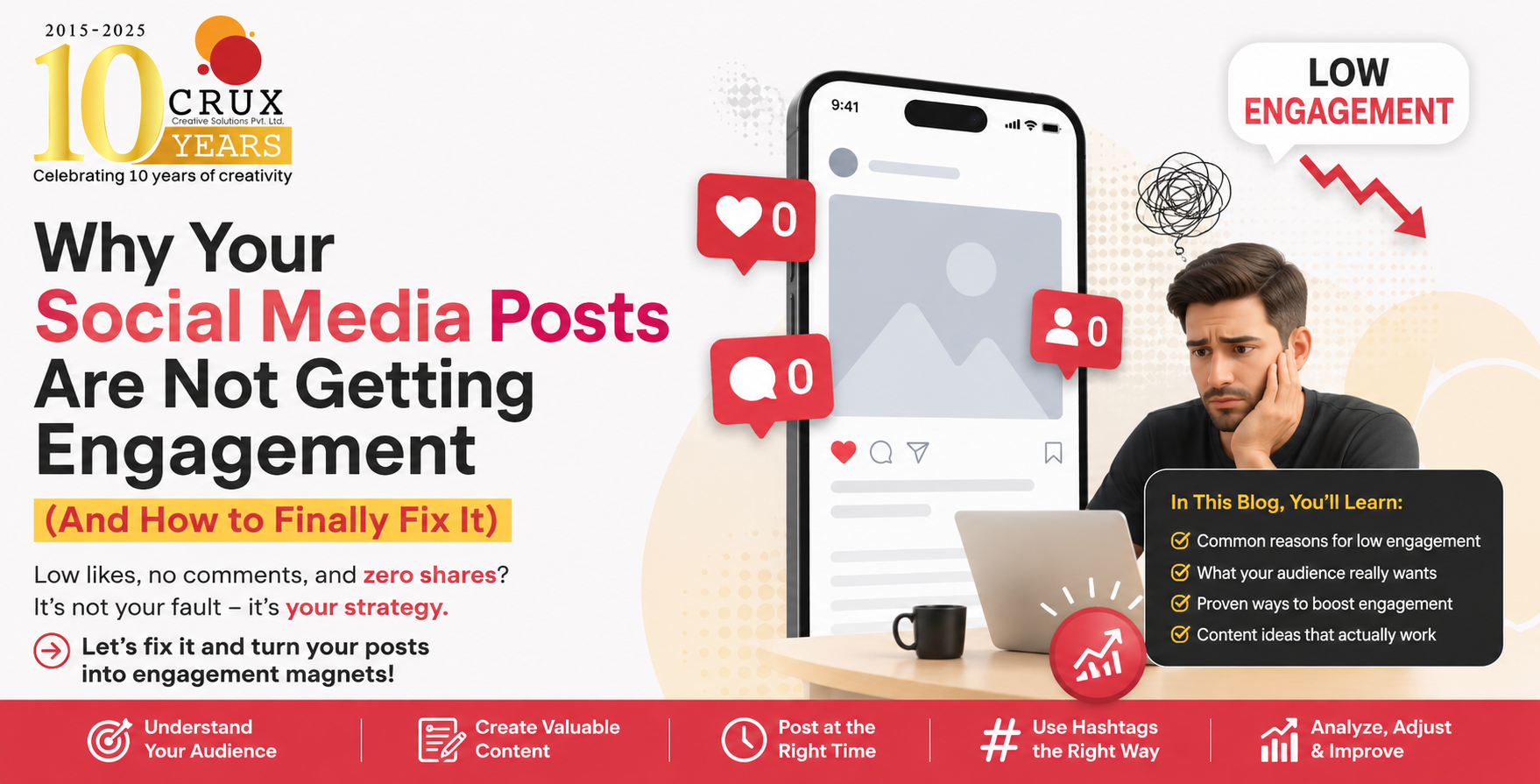
Why Your Social Media Posts Are Not Getting Engagement (And How to Finally Fix It)
You spend an hour crafting the perfect caption. You pick the most flattering photo, tweak the filter, nail the hashtags — and then? Crickets. Social media engagement doesn't just happen because you showed up. The digital landscape has transformed into a brutally competitive arena where attention is the most expensive currency, and most brands are simply not earning it. Posting content without a clear purpose is like opening a shop in the middle of a desert and expecting foot traffic. If your numbers are flatlining, the problem isn't the algorithm — it's almost certainly your strategy.
You're Posting Content, Not Conversations
Here's a mistake that kills reach before a post even breathes: treating social media like a billboard instead of a dialogue. Every thriving account you admire is doing something different — they are pulling people into a conversation, not pushing messages at them. Without a deliberate social media engagement strategy, even the most beautifully produced posts disappear into the void within minutes. Audiences today have developed a sixth sense for content that feels transactional, and they scroll past it without a second thought.
Think about the last post that made you stop scrolling. Chances are, it asked you something, challenged you, made you laugh, or stirred something you didn't expect. That's not accidental — that's engineered. When your captions end with a question, your Stories invite a poll, and your Reels spark a debate, you're activating the psychological triggers that drive people to comment, share, and save. Building genuine connection is the only sustainable way to increase social media engagement — and it starts with rethinking who you're talking to versus talking at.
Your Content Has No Strategic Direction
Random posting is the silent killer of brand growth. You might be putting out content daily, but if there's no thread connecting your posts — no theme, no audience journey, no brand voice — you're creating noise, not value. A well-built social media content strategy maps out what you post, when you post, why you post it, and what action you want your audience to take. Without that map, you're wandering.
Start by asking three foundational questions: Who exactly is your audience? What do they care about beyond your product? And what do they do after consuming your content? When the answers to those questions drive every creative decision you make, your content stops being generic and starts being magnetic. Brands that treat their feed as a curated editorial experience — rather than a product catalogue — consistently outperform competitors in reach and retention. Strategy isn't a document you write once; it's the operating system behind every single post.
The Visual Problem Nobody Talks About Enough
Scroll through your feed right now. Notice how instantly your brain decides what to stop at and what to skip? That decision happens in under 400 milliseconds — before a single word is read. Weak social media post design is one of the most common and most overlooked reasons brands bleed engagement silently, month after month. Colors, typography, layout, and visual hierarchy all signal whether your brand is worth paying attention to.
Great design isn't about being flashy — it's about being clear. Does the viewer instantly understand what this post is about? Does the visual make them feel something? Is the branding consistent enough that your audience recognizes your content without even seeing your handle? These are the questions professional designers obsess over, and the brands winning at social obsess over them too. If your graphics look like they were assembled in five minutes, your audience will give you exactly five seconds — and not a moment more.
What's Actually Killing Your Instagram Numbers…
Instagram, in particular, has become fiercely unforgiving to accounts that ignore its behavioral signals. The platform rewards saves, shares, and comments far more heavily than likes — which means optimizing purely for vanity metrics will actively hurt your visibility. Low social media engagement on Instagram often stems from one of several compounding issues that most creators don't catch until months of growth have already been lost.
Here's what's dragging your Instagram performance down — and what each problem actually means:
- Posting without a hook: Your first line of copy needs to create a pattern interrupt — something that makes the brain pause. If your caption opens with your brand name or a generic greeting, you've already lost the audience before they've read a word.
- Ignoring the Reels algorithm: Instagram's distribution engine heavily favors video, particularly Reels under 60 seconds with strong watch-through rates. Static-only feeds are getting punished in organic reach regardless of content quality.
- Inconsistent posting schedules: The algorithm rewards regularity. Posting five times one week and once the next confuses both the platform and your audience, suppressing your content's visibility window.
- No CTA (Call to Action): Every post needs to tell the audience what to do next — comment, share, save, visit the link. Without clear direction, even interested followers scroll past without engaging.
- Using banned or irrelevant hashtags: Hashtag strategy has evolved drastically. Stuffing posts with generic, high-volume tags often does more damage than good, flagging content as spam-like to the algorithm.
To genuinely improve Instagram engagement, you need to diagnose which of these is your primary bottleneck — and fix it systematically rather than guessing your way through.
Read Also : The Power of Social Media Marketing: Trends to Watch
You Don't Know What Your Audience Actually Wants
Assumptions are expensive in social media. Brands assume their audience wants product photos when they actually want education. They assume motivational quotes perform well when their specific community craves behind-the-scenes authenticity. A disconnected content engagement strategy is almost always rooted in this fundamental misread of what the audience values versus what the brand wants them to value.
The fix isn't complicated, but it does require humility. Go back through your last 30 posts and find the three that performed best — not based on your preference, but based on comments, saves, and shares. Then look for patterns: Was it the format? The topic? The tone? The time of day? Your audience has already told you what they want; you just haven't been listening carefully enough. Once you start reverse-engineering your own best-performing content, you create a data-driven feedback loop that consistently outperforms guesswork.
The Agency Advantage You're Possibly Missing
Some brands hit a ceiling that internal teams simply cannot break through — not because the team lacks talent, but because they lack bandwidth, objectivity, or access to platform-level insights. Partnering with a social media marketing agency can inject the kind of strategic clarity and creative firepower that transforms stagnant accounts into growth engines. Agencies work across dozens of industries simultaneously, which means they carry pattern recognition that no single in-house team can replicate.
The best agencies don't just manage posting schedules — they build systems. They run A/B tests on content formats, identify emerging trends before they peak, and track the metrics that actually predict long-term growth rather than just surface vanity numbers. When you're too close to your own brand to see what's not working, an outside perspective with deep platform expertise becomes one of the highest-ROI investments you can make. It's not about outsourcing creativity — it's about amplifying it.
Creative Execution Is Where Strategy Goes to Die
You can have the most brilliant strategy in the world, and a mediocre creative execution will bury it. This is where working with a social media creative agency becomes a game-changer. Creative teams that specialize in social understand the nuance between what looks good in isolation and what actually performs in a fast-moving feed environment. They know how to translate brand identity into scroll-stopping content that feels native to each platform.
The best social content is never an afterthought — it's the primary product. Copywriting, motion graphics, video editing, color grading, thumbnail design — each of these elements either elevates or undermines your credibility in the audience's eyes. Brands that treat creative quality as optional are competing with one hand tied behind their backs. When strategy and creative execution align, something remarkable happens: your content doesn't just perform, it compounds — building brand recognition and audience trust that becomes increasingly difficult for competitors to replicate.
Measuring Wrong Is as Bad as Not Measuring at All
Here's a trap that catches even experienced marketers: reporting on metrics that feel good rather than metrics that mean something. Follower count, impressions, and reach are useful context, but they are vanity metrics in isolation. If your numbers are growing but your community isn't commenting, sharing, or converting, you're building an audience that doesn't care — and that's a house of cards. Your social media marketing agency or internal analyst should be tracking engagement rate, saves, link-in-bio clicks, and story completion rates as primary KPIs.
Set a baseline for each metric before making any strategic changes, and then give each experiment at least four to six weeks before drawing conclusions. Social media growth is rarely linear — it surges, plateaus, and dips in cycles that require patience and data literacy to navigate. The brands that win long-term are not the ones who panic at every drop in impressions, but the ones who understand the story their data is telling and respond with precision rather than panic.
The Bottom Line: Engagement Is Earned, Not Hoped For
If you've read this far, here's the one truth to carry with you: low engagement is never random. It is always the result of something — a misaligned strategy, weak creative, inconsistent execution, or a disconnected understanding of your audience. The good news is that every one of those problems is fixable with the right insight and the willingness to change. Building real social media engagement is not about hacking the algorithm or chasing trends — it's about showing up with intention, creativity, and genuine value for the people you're trying to reach.
Read Also : 10 Graphic Designing Tips For Social Media To Get More Likes
Whether you work with a social media creative agency, build an in-house team, or fly solo, the principles remain the same: know your audience deeply, create with purpose, design for attention, and measure what matters. Social media rewards the brands that treat their community like people — not metrics. Start there, stay consistent, and the engagement will follow.
Ready to stop guessing and start growing? Audit your last 30 posts today with Crux — the answers are already there.

Princy Cycil
Meet Princy Cycil, Senior content writer of Crux, with 6 years of experience. She has written for tech, education, healthcare, finance, e-commerce, travel, FMCG, and lifestyle brands. A B.Com graduate, she started her career with accounting but realized she loves words more than numbers. She creates blogs, social media posts, and web content that connect and engage. When she's not writing, she's reading books, binge-watching Netflix, or sipping coffee.
Share:



 Shelly Bhasin Bawa