How Creative Fatigue Kills Paid Campaign Performance?
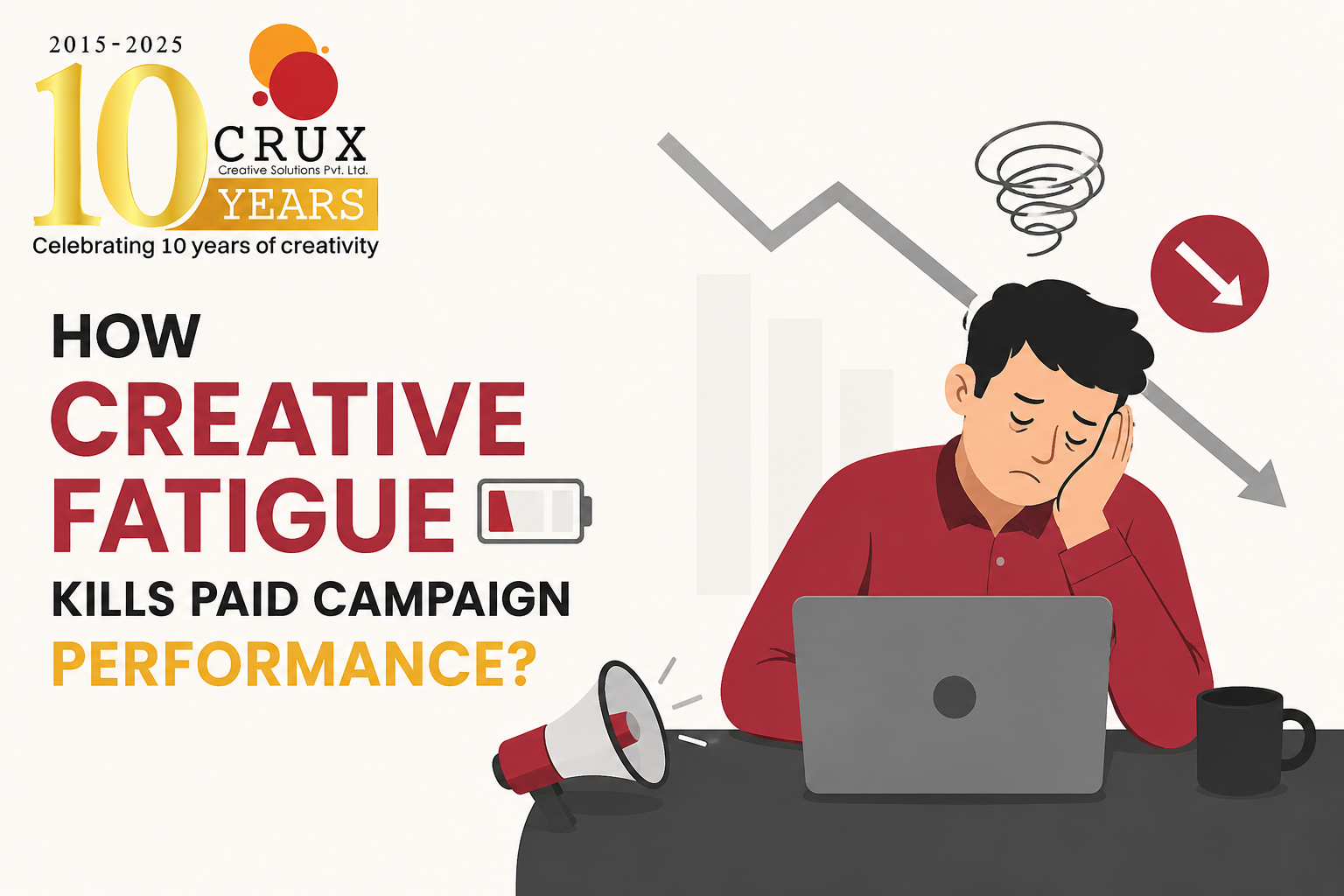
Most marketers know the feeling. A campaign launches strong — clicks are rolling in, the cost-per-click looks great, and the ROAS makes everyone smile. Then, slowly, almost without warning, the numbers start sliding. Creative fatigue is what happens when your audience sees the same ad so many times that they stop responding to it altogether. It is not a glitch, not a platform issue, and definitely not bad luck — it is a predictable pattern that hits every campaign eventually.
The tricky part? It does not announce itself loudly. Your ad is still running, the budget is still spending, and the dashboard looks busy — but the performance underneath has quietly hollowed out. Think of it like a joke told one too many times at a dinner table: the first time, people laugh; by the fifth time, they are already reaching for their phones. The same principle applies to your paid ads, and the damage compounds faster than most people expect.
Why Your Brain Tunes Out Repeated Ads?
The human brain is wired for novelty. Neuroscience tells us that new stimuli trigger dopamine responses, while repeated stimuli get filtered out as irrelevant — a process called habituation. When a user scrolls past your ad for the seventh time that week, their brain has already categorized it as background noise, no different from the hum of an air conditioner. The message stops landing, not because it was bad, but because it became too familiar. Now, ad fatigue sets in.
This is not a flaw in your targeting or your copy — it is basic human biology working exactly as designed. What makes it dangerous for advertisers is that the platforms keep charging you even when users have mentally checked out. You are essentially paying full price for impressions that carry zero persuasive weight. Understanding this biological mechanism is the first step toward building a paid media strategy that keeps your audience genuinely engaged.
The Numbers That Tell You Fatigue Has Set In
Data never lies, but it does whisper before it shouts. The earliest sign of creative fatigue is a rising frequency metric — when the average number of times one person sees your ad climbs past three or four within a week, you are entering risky territory. Close on its heels comes a declining click-through rate, often dropping 20 to 40 percent before most advertisers even notice the trend. By the time your cost-per-acquisition spikes, the damage is already weeks old.
Platform algorithms pick up on declining engagement signals quickly and start deprioritizing your ad in the auction. This creates a brutal compounding effect: fatigue reduces engagement, reduced engagement raises your effective CPM, higher CPMs eat your budget faster, and your reach shrinks even further. Keeping a weekly eye on frequency, CTR trends, and thumb-stop rates gives you the early warning you need to act before the spiral takes hold.
Read Also : How Branding and Creative Design Increase Business Growth?
The Warning Signs You Cannot Ignore
Spotting creative fatigue early saves budget and protects paid campaign performance momentum. Here are the key indicators to watch for across your campaigns:
- Frequency creeping above 3–4 per week: Once a single user is seeing your ad more than three times in a seven-day window, the law of diminishing returns has already kicked in. Anything above five is effectively wasted spend on a disengaged audience.
- CTR dropping without audience changes: If your click-through rate starts falling and you have not changed your targeting, it is almost never the audience's fault — it is your creative that has lost its pull. A 15 percent or greater week-over-week CTR drop is a red flag worth acting on immediately.
- Negative comments and ad hiding increasing: When users start clicking "Hide this ad" or leaving comments like "I keep seeing this," the platform's relevance scoring takes a hit — and so does your ad delivery efficiency. This feedback is direct, real-time intelligence from your audience.
- Engagement rate dropping while impressions stay high: High impressions with falling likes, shares, or saves means people are seeing the ad but actively choosing not to interact. Impressions are vanity; engagement is validation.
- Rising cost-per-click with stable bids: If your bids have not changed but CPC is climbing, the algorithm is telling you that your ad is losing the auction more often due to poor engagement signals. Your creative quality score is dropping, and you are paying the price — literally.
- Conversion rate declining on a previously stable funnel: Sometimes fatigue does not kill clicks — it kills conviction. Users may still click out of habit or curiosity, but they arrive at the landing page without the emotional momentum needed to convert, leading to a quiet but costly drop in conversion rate.
How Quickly Fatigue Hits Different Platforms?
Not all platforms are equal when it comes to how fast audiences burn out. Meta (Facebook and Instagram) audiences tend to hit fatigue faster because of how aggressive and precise the retargeting is — a warm audience can exhaust a creative in as little as five to seven days. Google Display and YouTube ads generally have more runway, given the sheer scale of inventory and the lower frequency caps inherent to broad contextual targeting. TikTok sits in an interesting middle ground: its algorithm actively surfaces new content aggressively, so a great creative can stay fresh longer — but when it dies, it dies fast.
Understanding your platform's typical fatigue window lets you plan creative refreshes proactively rather than reactively. A Meta retargeting campaign, for instance, should have at least three to four creative variations ready to rotate from day one. Treating each platform's fatigue curve as a known variable — not a surprise — is one of the hallmarks of a mature, high-performance paid media strategy.
The Creative Rotation Strategy That Actually Works
Rotation is not just about having more ads — it is about having the right variety. Swapping out one static image for a nearly identical one with a different background color will not meaningfully reset fatigue; the brain still recognizes the pattern. True creative rotation means changing the format (video vs. carousel vs. static), the hook (emotional vs. rational vs. curiosity-driven), and sometimes even the visual perspective entirely. Give the algorithm genuinely different creative signals to test, and it will find the freshest angle for you.
The smartest teams build what is called a creative pipeline, not just a creative library. That means new concepts are always in production — being shot, designed, or written — before the current ones need replacing. Waiting until fatigue hits to start creating is like waiting until the car breaks down to book a mechanic. A steady pipeline of four to six new creative concepts per month for active campaigns keeps performance stable and gives your team breathing room to produce quality work rather than panic-producing replacements.
Read Also : How to Choose the Right Creative Agency for Your Business?
Why Broad Audiences Buy You More Creative Longevity?
Here is something counterintuitive that a lot of performance marketers overlook: tighter targeting often accelerates fatigue. When your audience pool is small, each user within it gets hit with your ad far more frequently per day, burning through your creative at a much faster rate. Broadening your audience — even slightly — distributes impressions across more people, reducing individual frequency and extending the useful life of each creative asset. More people, less repetition per person, longer-lasting creative.
This does not mean abandoning precision targeting; it means being intentional about audience size relative to your daily budget. A $500/day budget against a 50,000-person audience will create fatigue brutally fast. Scale that audience to 500,000 with the same budget, and your creative suddenly has far more room to breathe. Matching your budget scale to your audience size is one of the most underrated levers in preventing creative burnout before it starts.
Refreshing Creatives Without Losing Momentum
The goal when refreshing is to reset novelty without abandoning what worked. Start by identifying the highest-performing element of your fatiguing ad — was it the headline, the offer, the visual style, or the call to action? Keep that element, and change everything around it. This approach lets you benefit from what the algorithm already learned about your audience while presenting enough newness to re-engage burned-out viewers. It is evolution, not revolution.
Another smart tactic is staggering your creative launches rather than replacing everything at once. Introduce a new creative while the existing one still has some life left, let the algorithm start gathering data on the new variant, and then gradually shift budget toward it as the older creative fades. This prevents the performance dip that comes with launching cold creatives against a warm audience with no prior signal. Smooth transitions preserve momentum; hard swaps often cause temporary performance drops that spook teams into making poor decisions.
Read Also: Top Marketing Tools and Tips From the Best Creative Agency in Gurgaon
Building a Fatigue-Proof Campaign Culture
The deepest fix is cultural, not tactical. Teams that treat creative as a one-time production task rather than an ongoing process will always be chasing fatigue rather than staying ahead of it. Building a culture where creative testing is continuous, data review is weekly, and new concepts are always in development changes the entire rhythm of how campaigns perform. Fatigue becomes a managed variable, not a crisis.
It starts with leadership giving creative teams the time, budget, and mandate to produce consistently — not just for big launches. Creative Design Agencies and in-house teams alike need to normalize the idea that a great campaign is never "done." The brands that sustain paid performance over the long haul are the ones that treat their creative library the way a chef treats a menu: always fresh, always seasonal, always evolving. Creative fatigue does not have to kill your campaigns. Recognized early and managed with intention, it is simply the cost of doing business — and one you can absolutely stay ahead of.
The bottom line: your ads are not immortal. But with the right systems and creative optimization, the right rotation strategy, and a team that watches the data closely, you can keep performance alive far longer than your competitors ever will.

Princy Cycil
Meet Princy Cycil, Senior content writer of Crux, with 6 years of experience. She has written for tech, education, healthcare, finance, e-commerce, travel, FMCG, and lifestyle brands. A B.Com graduate, she started her career with accounting but realized she loves words more than numbers. She creates blogs, social media posts, and web content that connect and engage. When she’s not writing, she’s reading books, binge-watching Netflix, or sipping coffee.
Share: