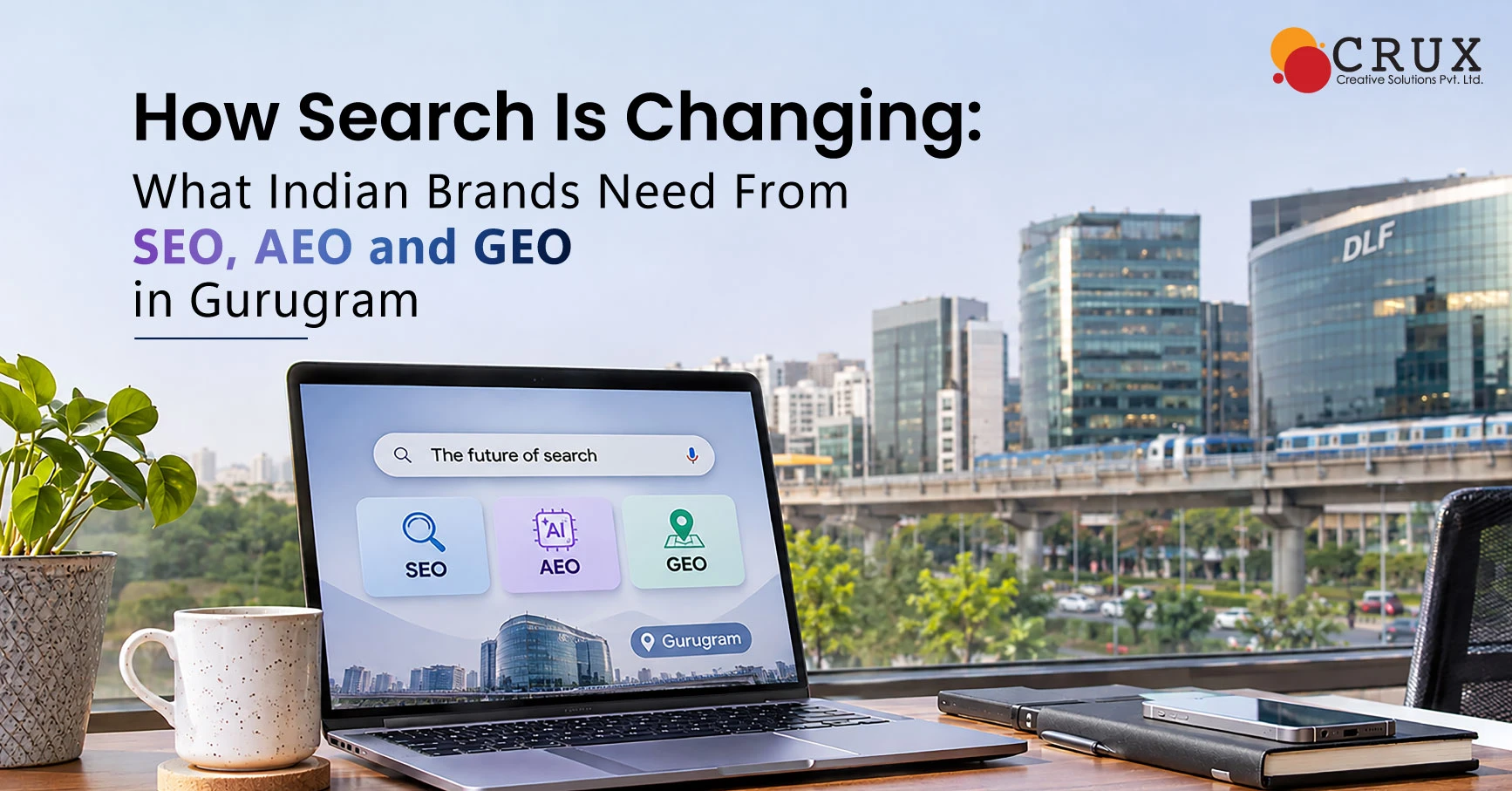
How Search Is Changing: What Indian Brands Need From SEO, AEO and GEO in Gurugram
Search is now a shopping partner, not a search box
Think back to how you searched for Diwali shopping a few years ago. You typed something short, like "Diwali gifts" or "silk saree online", and scrolled through ten blue links. That habit is fading fast.
Today, Google Search is an AI search. People talk to it the way they would talk to a knowledgeable friend. They ask follow-up questions, upload photos, jump to YouTube, check a store on Maps, and come back to Search to confirm a refund policy before paying.
Shelly Bhasin Bawa, CEO of Crux Creative Solutions, has watched this shift play out first-hand while guiding brands through peak seasons like Diwali, Dussehra and the wedding rush. This article distils her perspective on what AI-led search means for brands and what to do about it.
If you run a D2C brand, an ecommerce store or a local business and you are wondering whether you need an AEO agency in Gurugram, a GEO agency in Gurugram, or simply a stronger SEO company in Gurugram, this guide will help you understand what actually moves the needle in AI-driven search.
How Indians are searching for products differently
Shoppers now treat AI search as an expert advisor. Instead of short, isolated keywords, they hold long conversations across several touchpoints. According to Google, queries in AI Mode are up to three times longer than traditional searches.
Those conversations build real buying confidence. A shopper buying a mixer grinder can ask whether it handles idli batter, whether the warranty covers the motor, and whether it will arrive before Dhanteras, and get every answer in one conversation. By the time something lands in the cart, the decision feels settled. In Google's own survey, 87% of users said AI Mode and AI Overviews help them make confident buying decisions.
For brands, this shift means three things:
- Shoppers are curious and want depth. Your content has to be rich enough to power their research and inspire them, not just list a price and a size chart.
- Intent is fluid, not static. People move between Search, YouTube and Maps and can decide to buy at any point. A single keyword strategy cannot cover that journey.
- Consideration is never fixed. Someone may set out to buy a big-name smartwatch, watch a few creator reviews praising a homegrown Indian label, and end up buying that instead. You need to be present through the entire consideration journey, not only at the search and checkout moments.
This is exactly why the conversation around AEO (Answer Engine Optimisation) and GEO (Generative Engine Optimisation) has grown so loud. But as we will see, the fundamentals have not changed as much as the buzzwords suggest.
Learn more about the SEO Cost in India
Visual search: if your catalogue is one white-background photo, you are invisible
People do not think in text keywords. They see something they like and want to find it. Shelly Bhasin Bawa, CEO of Crux Creative Solutions, describes a moment most of us know: at a friend's sangeet, you spot a guest in a striking hand-block-printed jacket. You have no idea what the print is called, so typing it into a search bar goes nowhere. One quick photo and a Google Lens search later, you are looking at similar jackets and the stores that sell them.
This behaviour is happening at an enormous scale. Google sees close to 25 billion Lens searches every month, and roughly one in five carries commercial intent.
Two features matter most here:
- Google Lens with a prompt. A shopper can photograph a brass table lamp at a café and add "similar lamp under ₹3,000". Lens combines the image with the budget and returns matching options.
- Circle to Search. While watching a home-décor video, a shopper can circle a cushion cover on the sofa and instantly see where it, or something similar, is sold.
Both work by linking visual signals to Google's Shopping Graph, which holds around 60 billion live product listings. The system reads fabric, texture and price, then filters results automatically.
The minimum visual assets every product needs
In a visual-first world, a single studio shot is not enough. Shelly's recommended baseline for retail brands:
- At least three high-resolution lifestyle images per product. Show the texture up close, a kurta at a morning puja versus an evening party, or a handbag on a weekday commute versus a weekend getaway.
- Detailed close-ups, especially for handcrafted products or unique embroidery where the detail is the selling point.
- A short video clip that shows the unboxing or how a lehenga flares when someone twirls.
Any serious provider of SEO services in Gurgaon should be auditing your image library, alt text, product schema and Merchant Center feed with this visual-first lens, not just your keyword rankings.
Read more : If AI Can’t Find Your Brand
Winning the five-minute decision
We have all done it: research a product for days, then buy it in five minutes. What tips the balance in that final window is usually validation, and Google Search plays a central role in it.
Google's studies show that seven out of ten festive shoppers who spot a product on social media turn to Google Search to evaluate it. Even users of other AI chatbots use Google Search 1.3 times more than non-users. Think about booking a deep-cleaning service before Diwali: you may find one through an Instagram ad, but you still check its Google reviews before letting anyone into your home.
Google therefore plays a double role. It powers discovery by putting brands in front of shoppers, and it acts as the final validation engine that answers questions about quality, delivery, refunds and reputation. Three tools help brands win this moment:
- AI Max for Search. Intent is now multi-layered. A shopper may start with "silver pooja thali for gifting" and move on to whether it is hallmarked, how much it weighs, and whether it tarnishes. You cannot add every variation as a keyword. AI Max reads your website and matches the best landing page and asset to the shopper's question, whether or not that exact keyword exists in your account.
- Business agents. Right before checkout, most shoppers have one nagging question. Is cash on delivery available on my pincode? Can I exchange the size if it doesn't fit? AI experiences can now scan your website and answer instantly, but only if the answer actually exists on your site. Content gaps here directly cost you sales.
- Promo mode. Search campaigns usually need time to learn when something changes. Promo mode, available with Performance Max, tells the system you are entering a promotion window. If your Diwali offer says "flat ₹500 off on orders above ₹2,500", it pushes that offer to shoppers actively hunting for deals.
Notice the common thread: every one of these depends on your website having clear, complete, trustworthy content. That is SEO work, whatever label you put on it.
Growing brand, limited budget? Use AI as the equaliser
Founders often say the festive season feels too cluttered and expensive to compete in. The view of Shelly Bhasin Bawa, CEO of Crux Creative Solutions, is that Google's AI is the great equaliser for growing brands: you do not need the biggest budget, you need the smartest strategy. Her three recommendations:
- Chase ready-to-buy customers, not keywords. Do not try to copy every keyword a market leader converts on. Start with a lean keyword set, switch on AI Max or Performance Max with strong assets, and set the return on ad spend (ROAS) you need. Google's AI reads many signals beyond the keyword to find people likely to convert.
- Tell the AI what profit means for you. AI is only as smart as the data you feed it. Be explicit about whether you value clicks, traffic, conversions, or only orders above ₹3,000. An ₹800 order and an ₹8,000 order do very different things for your business, so value them differently.
- Switch on promo mode for festive peaks. Indian festive shopping behaves differently. People hunt for Diwali- and Dussehra-specific deals over a two- or three-day window. Promo mode gives the system that signal immediately instead of waiting for it to learn.
Shelly adds one more layer from her work with brands. Map your business economics before you hand anything to AI. Which products carry the best margins? Which ones bring new customers into your ecosystem? Which landing pages lead people to add extra items to the cart? Feeding those bottom-funnel signals into your campaigns, and building the pages that support them, is where paid media and SEO start working together.
Recommended Read : SEO vs AEO vs GEO
How to show up in AI Overviews, AI Mode and Gemini
This is the question every business owner is asking: how do I get my products recommended when someone asks Google's AI what to buy?
The most important insight from the conversation is simple. Google does not maintain a separate index for AI Overviews and AI Mode. The same index powers both traditional results and AI answers. As Shelly Bhasin Bawa puts it to every brand she advises, good SEO is good GEO.
So you do not need to throw out your SEO strategy. You need to execute it better, around three principles.
1. Write for curious shoppers, not for crawlers
If everyone uses AI to generate the same generic product copy, nobody stands out, and shoppers do not get the answers they want. Instead, mine real customer curiosity:
- Your Google Ads search terms report, which shows exactly how people phrase questions about your brand.
- Comments on your YouTube videos and social posts.
- Questions your customer support team hears every week.
Answer all of it comprehensively, ideally in one place on your own website. Back those answers with genuine customer reviews, and your claims become validated facts in the eyes of both shoppers and AI systems.
2. Make your brand visual
AI experiences can pull high-quality photos and reviews straight from your website, and some AI-surface ads now show a product image alongside a review. Rich, real-world imagery on your site is already a form of AI SEO optimisation.
3. Give AI real-world facts
Your Merchant Center product feed and Google Business Profile are rich data sources. Do not fill them with generic text. Google's feed has around 20 attributes, so complete every one with granular detail: fabric type, store availability, delivery cut-offs, refund terms and more. These are precisely the facts that settle a five-minute purchase decision.
What this means for AEO and GEO
Many brands wonder whether they should hire a separate team or a dedicated AEO agency in Gurugram alongside their existing SEO partner. If your fundamentals are strong, you are already most of the way there. Brands with solid SEO are seeing their pages surface in AI Mode and AI Overviews, and Search Console reporting gives a useful starting point for spotting which pages already appear in AI experiences, so you can double down on them.
The practical takeaway: the right GEO agency in Gurugram is really a strong SEO partner that understands conversational queries, structured product data, visual assets and content depth.
Don't ignore YouTube: India is a YouTube-first market
In many countries, search activity is concentrated on google.com. India is different. A large share of product searches also happens on YouTube, and shoppers move back and forth between the two across many touchpoints before buying.
Two practical points stood out:
- Images and videos help you appear on YouTube too. Ads also show on YouTube search results, so brands with image and video assets added to their campaigns have a better chance of appearing when someone searches for related categories there.
- Demand Gen carries your learnings forward. Shelly compares YouTube discovery to a walk through Chandni Chowk: you weren't planning to eat, but the sight and sizzle of fresh jalebis pulls you to the counter anyway. Demand Gen is Google's YouTube-first performance product for that kind of discovery. Learnings and assets from Performance Max can be switched on in Demand Gen, so you are not starting from scratch.
Google's recommendation is to run Search, Performance Max and Demand Gen together. Advertisers using all three tend to see more conversions than those who don't. Festive season, when intent is at its peak, is an ideal time to expand across the ecosystem and build a head start that pays off long after the sales end.
There is an organic angle here as well. YouTube videos that answer real buyer questions, such as fit, fabric, unboxing and comparisons, feed the same curiosity that AI search rewards. Good SEO in 2026 includes a video plan.
What to look for in an SEO company in Gurugram for the AI search era
Gurugram has no shortage of agencies now calling themselves AEO or GEO specialists. Based on everything above, here is a practical checklist for evaluating any partner offering SEO services in Gurgaon:
| What to ask | Why it matters in AI search |
| Do they build content around real customer questions, using search terms reports, reviews and support logs? | AI answers favour comprehensive, specific, validated content over generic copy. |
| Do they audit your Merchant Center feed and Google Business Profile attribute by attribute? | Granular product facts settle purchase decisions and feed AI shopping results. |
| Do they have a plan for images, video and visual search? | Lens and Circle to Search drive billions of commercial searches every month. |
| Do they fill gaps in policy content: returns, refunds, delivery, warranties? | AI agents can only answer pre-checkout questions your site actually answers. |
| Do they report on AI Overview and AI Mode visibility, not just rankings? | Shows which pages already surface in AI experiences and where to double down. |
| Do they connect SEO with Search, Performance Max and Demand Gen signals? | Paid and organic share the same customer journey and the same data. |
| Do they talk about your margins and customer value, not just traffic? | AI optimises toward whatever you define as success. |
Be cautious of anyone selling AEO or GEO as a completely separate, mysterious discipline that replaces SEO. As Google itself puts it, there is no separate index. The best AEO agency in Gurugram is one that does the fundamentals exceptionally well and adapts them to conversational, visual and multi-touchpoint search.
The bottom line
Search has not shrunk in the AI era; it has grown. Google now handles over five trillion searches a year, and commercial queries keep rising. People are asking longer, richer and more visual questions, which means more chances for brands to be found, if they are ready.
The brands that win will be the ones that:
- Create content for curious shoppers, answering every dimension of their questions, not just a short FAQ.
- Treat their catalogue as visual and their product feed as a source of real-world facts.
- Give AI the right business signals, so it optimises for profit rather than just traffic.
- Show up across Search, YouTube and Maps, not only at the final click.
As Shelly Bhasin Bawa often reminds clients, content leads to commerce. The fundamentals of good SEO remain the fundamentals of good AEO and GEO; they simply demand more depth, more visuals and better data than before.
Ready to get your brand found in AI search? If you are looking for an SEO company in Gurugram that understands AI Overviews, AI Mode and the full Google ecosystem, Crux Creative Solutions can help. Get in touch for an AI search readiness audit of your website, product feed and content.
Call Us : 9109286855
Email : reachout@cruxcreativesolutions.com

Shelly Bhasin Bawa
Meet Shelly Bhasin Bawa, Founder & CEO of Crux Creative Solutions, with over 28 years of experience across branding, advertising, digital marketing, events and integrated communications. Over the years, she has worked with diverse brands across industries, helping them build stronger identities, sharper communication and more effective marketing strategies. Known for combining creative instinct with business thinking, Shelly writes about branding, digital marketing, agency life, leadership and the changing role of AI in creativity. When she's not building brands or mentoring teams, she's usually exploring new ideas, travelling, staying fit or sharing her perspective on LinkedIn.
Share:


 Princy Cycil