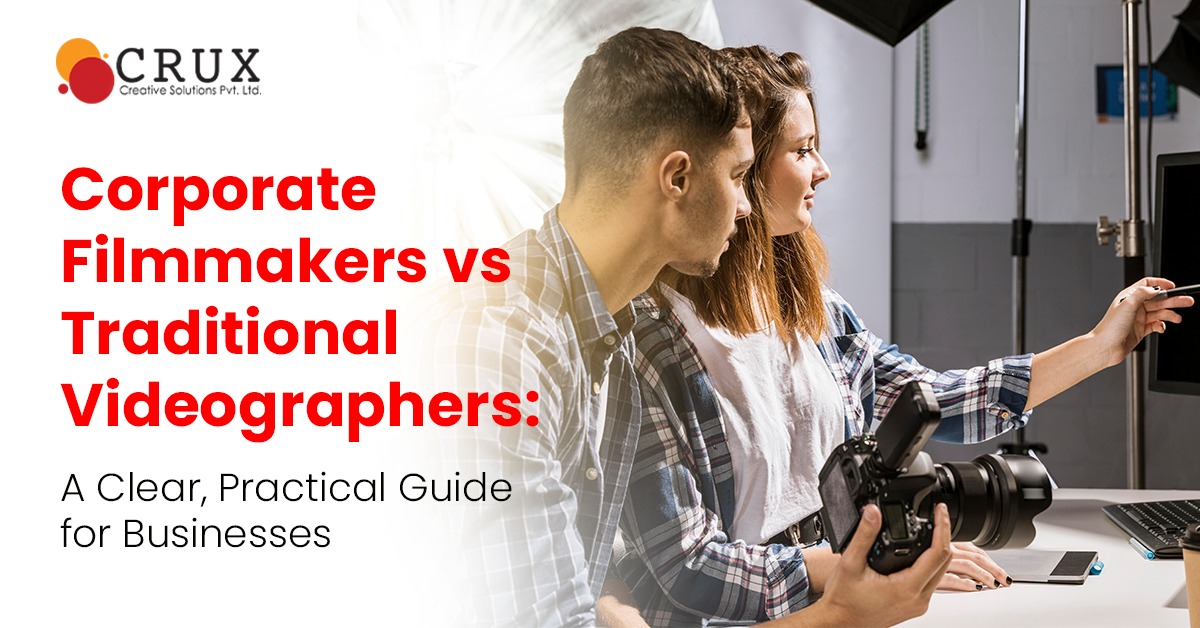
Corporate Filmmakers vs Traditional Videographers: A Clear, Practical Guide for Businesses
Video has become one of the most effective ways for businesses to communicate. It helps brands explain what they do, build credibility, introduce products, and engage people across digital platforms. As companies invest more in video, many face a familiar question. Should they hire a corporate filmmaker or work with a traditional videographer?
At first glance, both appear similar. Cameras, lights, editing software, and final video files are part of both roles. The real difference lies in intent. One records moments. The other builds messages. Understanding this difference helps businesses avoid mismatched expectations and wasted budgets.
What Traditional Videographers Typically Do?
Traditional videographers focus on documenting real-life events. Their work is centered around capturing what happens as it unfolds. This could be a wedding, a family celebration, a cultural function, or an internal gathering. The goal is not to guide the viewer or influence a decision, but to preserve the moment faithfully.
Planning is usually limited to logistics. The videographer understands the venue, checks lighting conditions, and prepares equipment. Creativity comes from reacting quickly and framing moments well, rather than from scripted storytelling. The final output is a record of an experience, meant to be watched by people who already know the context.
How Business-Focused Video Work Differs?
When video is created for business use, the approach changes completely. These projects begin with questions, not cameras. Who is the audience? What do they need to understand? What should they do after watching the video? The answers shape the entire production process.
This type of work is not limited to filming. It involves structuring information, selecting visuals that support meaning, and presenting ideas in a clear sequence. The video becomes a communication asset rather than a memory.
Purpose Shapes the Entire Process
Documentation and communication serve very different purposes. A traditional video exists to record reality. It shows what happened. There is no need to simplify, persuade, or direct the viewer.
Business videos exist to clarify ideas and influence perception. They may need to explain a product, build trust, or support decision-making. Because of this, every creative choice is intentional. The purpose determines the length, tone, visuals, and even the pace of the edit.
Planning Beyond the Shoot Day
For event coverage, preparation is practical. Knowing where to stand, when key moments occur, and how to manage sound is enough. Much of the work happens on the day itself.
In contrast, business video projects invest time before filming begins. Scripts are written. Visual sequences are planned. Messaging is reviewed. This preparation reduces confusion during production and ensures the final output aligns with expectations. Clear planning also helps teams stay focused and efficient.
Storytelling Without Being Linear
Event videos usually follow time. The sequence mirrors real life. This approach works when the viewer wants to relive the experience.
Business storytelling does not need to follow time. It follows logic. A video may begin with a problem, shift to a solution, and end with direction. This structure keeps attention and makes information easier to absorb. The viewer is guided, not left to interpret meaning on their own.
Audience Awareness Changes Everything
Traditional videos are watched by people who already understand what they are seeing. They recognize faces, places, and moments. No explanation is required.
Business audiences are often unfamiliar. They may be seeing the brand for the first time. This means visuals, language, and pacing must be carefully considered. Confusion leads to disengagement. Clarity keeps viewers watching.
Skills That Go Beyond Equipment
Operating a camera well is essential in both roles. However, business video work demands additional skills. Understanding brand voice, visual consistency, and viewer behavior is just as important as technical ability.
Many organizations work with an animated explainer video company gurgaon when they need to present complex ideas in a simple, visual way. Animation allows concepts to be broken down without relying on live footage alone, making explanations clearer and more engaging.
Editing as a Communication Tool
Editing for events focuses on mood and flow. Music, transitions, and highlights help recreate the atmosphere of the occasion.
Editing for business videos focuses on understanding. Visual hierarchy, on-screen text, and pacing are used to guide attention. Videos are often adapted for different platforms, which is why many brands rely on Social Media Video Production Services to ensure consistent performance across formats.
Distribution Is Planned, Not Accidental
Event videos are usually delivered as a single file and shared privately. Their lifecycle is limited.
Business videos are designed for reuse. The same content may appear on websites, presentations, emails, and social media. Planning for distribution from the start ensures the video remains useful long after launch.
Explainer Videos and Structured Communication
Explainer videos are a common requirement for businesses introducing products or services. They help reduce confusion and shorten decision-making time. This format requires clear scripting and visual logic, not event-style filming.
For this reason, companies often collaborate with an explainer video production company Gurugram that understands how to structure information without overwhelming the viewer.
Product Videos and Online Sales
Selling products online requires more than static images. Video helps customers understand size, usage, and benefits. These videos are carefully staged to build confidence.
An Ecommerce Product Video Production Company focuses on clarity and persuasion, ensuring the viewer understands both the product and its value. This approach is very different from documenting an event or activity.
Cost Versus Long-Term Value
Traditional videography is usually more affordable and suitable for short-term needs. The value lies in emotional recall.
Business video projects may require higher investment, but they deliver ongoing value. A single video can support marketing, training, and communication across multiple channels. The return comes from repeated use and measurable outcomes.
Process and Collaboration Style
Event-based projects follow a direct path. Capture, edit, deliver.
Business video projects involve collaboration. Feedback cycles, revisions, and approvals ensure alignment. While this takes more time, it also reduces risk and improves results.
Measuring Success
Success in traditional videography is subjective. If the moment is captured well, the job is done.
For business video, success is tied to outcomes. Engagement, clarity, conversions, or internal feedback help measure effectiveness. The video is judged by how well it performs, not just how it looks.
Key Differences: Corporate Filmmakers vs. Traditional Videographers
| Aspect | Corporate Filmmakers | Traditional Videographers |
| Primary purpose | Communicate a business message and drive outcomes | Capture and document real-life events |
| Focus | Strategy, storytelling, and audience understanding | Moment capture and event coverage |
| Planning level | Detailed pre-production with scripting and structure | Basic planning focused on logistics |
| Storytelling style | Narrative-driven and goal-oriented | Chronological and event-based |
| Audience | Customers, employees, investors, and public viewers | Friends, family, and event attendees |
| Role of editing | Used to guide understanding and attention | Used to preserve mood and flow |
| Use of graphics and text | Frequently included to explain and reinforce messages | Minimal or rarely used |
| Platform optimization | Designed for multiple platforms and formats | Usually delivered as a single video |
| Business understanding | Requires brand and communication insight | Limited to recording the event |
| Measurement of success | Based on engagement, clarity, or conversions | Based on visual quality and coverage |
| Long-term value | Reusable business asset | One-time viewing or personal use |
| Typical use cases | Brand films, explainer videos, training, product videos | Weddings, functions, ceremonies, events |
Making the Right Choice
When the goal is to document an event or preserve a memory, traditional videography is the right choice. When the goal is to explain, influence, or support growth, business-focused video production delivers far greater value.
Closing Thought
The difference between corporate filmmakers and traditional videographers is not about quality or creativity. It is about intention. One captures reality. The other shapes understanding. For businesses, choosing the right approach ensures video becomes a tool that works, not just content that exists.
FAQs
1. How long does a corporate video project usually take?
A corporate video timeline depends on planning depth and approvals. Short videos may take two to three weeks, while larger projects can take a month or more. Time is often spent on scripting, revisions, and alignment rather than just filming.
2. Can one video be reused across multiple platforms?
Yes. A well-produced corporate video can be adapted into shorter cuts, vertical formats, or teaser versions. This allows businesses to use the same content across websites, presentations, and different social media platforms without reshooting.
3. Do corporate videos need professional actors?
Not always. Many corporate videos feature real employees, leaders, or customers. This often increases authenticity and trust. Actors are used only when the concept requires dramatization or when consistency and controlled messaging are critical.
4. How do businesses measure the success of a corporate video?
Success is measured using engagement metrics such as views, watch time, click-through rates, and conversions. Internally, feedback, training completion rates, or clarity of communication can also indicate how effective the video has been.
5. Are subtitles really necessary for business videos?
Subtitles improve accessibility and help viewers understand content in sound-off environments. They also support multilingual audiences and improve retention. Many viewers prefer reading along, especially on mobile devices or in professional settings.
6. What should businesses prepare before starting a video project?
Businesses should clarify objectives, target audience, key messages, and usage platforms. Having brand guidelines, reference videos, and approval stakeholders ready helps streamline the process and avoids delays during production and review stages.

Princy Cycil
Meet Princy Cycil, Senior content writer of Crux, with 6 years of experience. She has written for tech, education, healthcare, finance, e-commerce, travel, FMCG, and lifestyle brands. A B.Com graduate, she started her career with accounting but realized she loves words more than numbers. She creates blogs, social media posts, and web content that connect and engage. When she’s not writing, she’s reading books, binge-watching Netflix, or sipping coffee.
Share: